Inventory Drought Meets Global Shockwaves
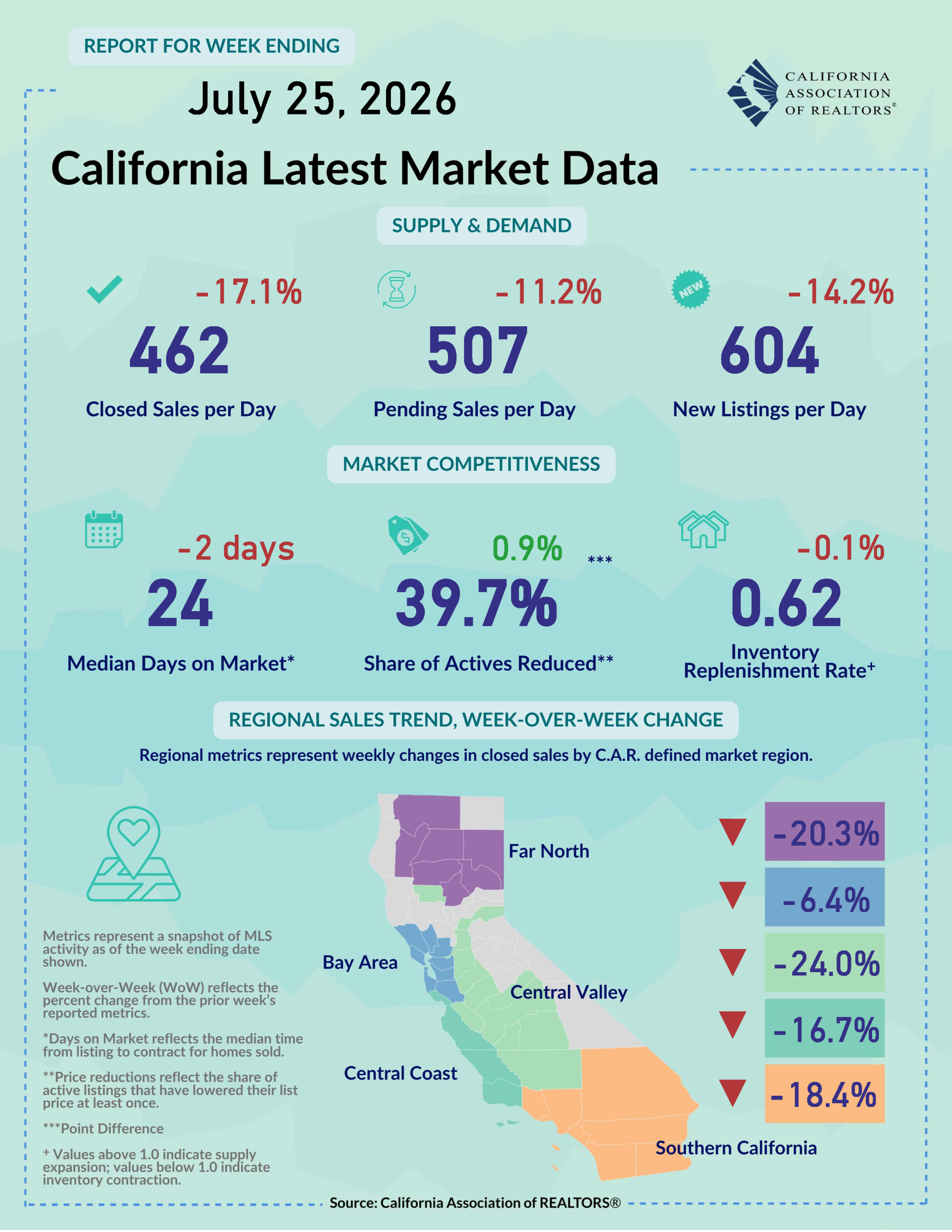
The California real estate market faced a highly notable, sweeping mid-summer cooldown for the week ending July 25, 2026, according to the latest data from the California Association of REALTORS® (C.A.R.). Statewide, daily closed sales tumbled by 17.1%, pending sales fell by 11.2%, and new listings dropped by 14.2%.
For the highly sought-after South Bay cities—spanning from coastal enclaves like Manhattan Beach and Redondo Beach to inland hubs like Torrance and Gardena—these headwinds are translating into distinct localized challenges. Mirroring the broader Southern California region, which experienced a sharp 18.4% week-over-week contraction in closed sales, the South Bay is seeing buyers and sellers enter a temporary holding pattern.
Despite the drop in sales volume, market competitiveness remains fierce due to an ongoing supply crunch. The state’s inventory replenishment rate slid to 0.62, signaling continued contraction. However, properties that do hit the market are moving rapidly; the median days on market shortened by two days to 24 days. Concurrently, 39.7% of active listings underwent price reductions, offering selective opportunities for persistent buyers.
Beyond localized metrics, macroeconomic pressures are shaping the South Bay landscape. Rising energy costs and geopolitical tensions continue to complicate the interest-rate outlook, while rising homeownership expenses have driven up foreclosures. In California, one in every 3,205 homes faced a foreclosure filing in June, though volumes remain comfortably below historical norms. Furthermore, a recent report highlighted ongoing racial disparities in homeowners insurance, with California’s Black and Hispanic households paying annual premiums of $280 and $63 more, respectively, adding another layer to the region’s affordability crisis.
As the summer progresses, South Bay buyers are increasingly adopting a cautious wait-and-see strategy. Success in navigating this tight, exceptionally fast-moving real estate market will ultimately require a keen eye on shifting local neighborhood prices and broader global economic signals.
Source: California Association of REALTORS® (C.A.R.)